
2024-Present
Abstract
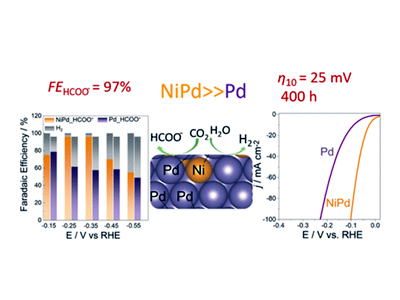
Electrochemical H2 generation and CO2 reduction address the energy and environmental crisis plaguing the world. An efficient electrocatalyst would require the lowest overpotential for these reactions. Given its position on the volcano plot near platinum, palladium presents itself as a viable alternative for the hydrogen evolution reaction (HER). However, the activity is limited by a high overpotential. It is also a good electrocatalyst for the CO2 reduction reaction (CO2RR) due to the favorable position of the d-band center. Nevertheless, the CO poisoning of the active site results in low electrocatalytic stability. Herein, we report a Ni-incorporated palladium catalyst, NiPd, which reduces water to H2 at a very low overpotential of 25 mV (η10). Furthermore, it reduces CO2 to formate with a very high faradaic efficiency of 97% at a potential of −0.25 V (vs RHE). DFT studies show that Ni inclusion leads to the facile activation of CO2 due to a bent adsorption configuration at the catalyst surface. The NiPd catalyst exhibits a strong and stable performance for HER (400 h) as well as for CO2RR (9 h) with high structural integrity as proven by postreaction characterization studies.
Abstract
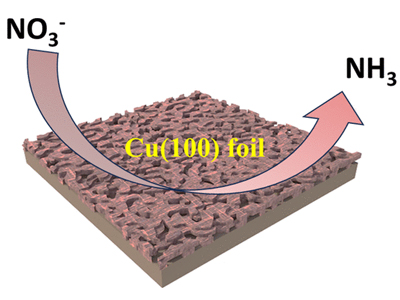
The electrochemical reduction of nitrate (NO3–) ions to ammonia (NH3) provides an alternative method to eliminate harmful NO3– pollutants in water as well as to produce highly valuable NH3 chemicals. The NH3 yield rate however is still limited to the μmol h–1 cm–2 range when dealing with dilute NO3– concentrations found in waste streams. Copper (Cu) has attracted much attention because of its unique ability to effectively convert NO3– to NH3. We have reported a simple and scalable electrochemical method to produce a Cu foil having its surface covered with a porous Cu nanostructure enriched with (100) facets, which efficiently catalyzes NO3– to NH3. The Cu(100)-rich electrocatalyst showed a very high NH3 production rate of 1.1 mmol h–1 cm–2 in NO3– concentration as low as 14 mM NO3–, which is 4–5 times higher than the best-reported values. Increasing the NO3– concentration (140 mM) resulted in an NH3 production yield rate of 3.34 mmol h–1 cm–2. The durability test conducted for this catalyst foil in a flow cell system showed greater than 100 h stability with a Faradaic efficiency greater than 98%, demonstrating its potential to be used on an industrially relevant scale. Further, density functional theory (DFT) calculations have been performed to understand the better catalytic activity of Cu(100) compared to Cu(111) facets toward NO3–RR.
Abstract

Graphite has been used extensively for Li-ion batteries (LIBs) due to its low cost, abundant resources, and long-term stability. However, graphite exhibits limited capacity in LIBs, significantly poor capacity in Na-ion batteries (SIBs), and inferior cycling stability in K-ion batteries (PIBs), which hinders the development of sustainable next-generation battery technologies. Heteroatom doping and tuning interlayer spacing are known to be effective solutions for carbon-based materials. Such modified anodes can exhibit high capacity and cyclability with numerous active sites. Here, we report boron-doped thermally exfoliated graphene (BTEG), which exhibits a high reversible capacity of 1014 mA h g−1 (LIBs), 295 mA h g−1 (SIBs), and 369 mA h g−1 (PIBs) at a current density of 25 mA g−1. We used operando/in situ measurements such as Raman spectroscopy and electrochemical impedance spectroscopy to investigate the fundamentals involved during the real-time phenomenon of BTEG/alkali-ion batteries. Consequently, it helps assess the reaction mechanism and kinetics to establish a structure–performance relationship for all three batteries with the BTEG anode. Finally, based on solid electrolyte interphase (SEI) understanding and electrolyte tuning, highly reversible batteries were attained for up to 1000 cycles at a high current density of 1 A g−1.
Abstract
Hybrid water electrolysis with the simultaneous generation of hydrogen and value-added chemicals enhances the viability of the water electrolysis process. A remarkably high current density of 1.4 A cm−2 toward benzyl alcohol oxidation (BOR) at a low potential of 1.45 V reported in this work suggests that the oxygen evolution reaction (OER) can be replaced with BOR by selecting a suitable catalyst. A chromium oxide-treated Ni foam (Cr-NF) synthesized through a simple hydrothermal route offers 100% conversion and 99.5% faradaic efficiency toward benzoic acid. The surface nature of NF is significantly modified by chromium oxide, known for its hydrophilic nature and pore-forming abilities, resulting in enhanced active sites. In situ Raman analysis confirms the reversible electrochemical conversion of Ni hydroxides to NiOOH, which converts benzyl alcohol (BA) to benzoic acid (PhCOOH) by chemical oxidation. The theoretical analysis suggests accelerated electronic transport and lower free energy for the sorption of intermediates utilizing the Cr2O3/NiOOH surface. In a two-electrode arrangement, Cr-NF demonstrates excellent performance, achieving a current density of 2.5 A cm−2 at an applied potential of 3.1 V, which is highly significant compared to OER-based systems. This system can further be studied for commercial applications.
Abstract
Urea-assisted water electrolysis is a promising and energy-efficient alternative to electrochemical water splitting due to its low thermodynamic potential of 0.37 V, which is 860 mV less than that needed for water splitting (1.23 V). Ni(OH)2 has proven to be an efficient catalyst for this reaction. However, the non-spontaneous desorption of CO2 molecules from the catalyst surface leads to active site poisoning, which significantly impacts its long-term stability. Herein, we have demonstrated that Pd incorporated NiOH2 (Pd/Ni(OH)2) results in a significant decrease in the overpotential by 40 mV at 10 mA cm−2 as compared to Ni(OH)2. The decrease in the Tafel slope and charge transfer resistance of Pd/Ni(OH)2 indicates an improvement in the kinetics of the reaction, resulting in a maximum current density of 380 mA cm−2 at 1.5 V, which is higher than that observed for Ni(OH)2 (180 mA cm−2). XAS analysis was utilized to determine the nature of the metal species in the catalyst. It revealed that while Pd predominantly exists in its metallic state within the bulk of the catalyst, the surface is enriched with the oxide phase. The presence of Pd prevents the strong adsorption of CO2 at the active site in Pd/Ni(OH)2, resulting in a substantial improvement of stability of up to 300 h as compared to Ni(OH)2. DFT calculations were performed to explore the detailed reaction mechanism of urea oxidation on Ni(OH)2 and Pd/Ni(OH)2. These calculations provided further insight into the experimental observations and evaluated the contribution of Pd in enhancing the catalytic efficiency of Ni(OH)2. Additionally, the operando Raman and IR spectroscopy were used to understand the formation of the active sites and the intermediates during urea electrooxidation.
Abstract
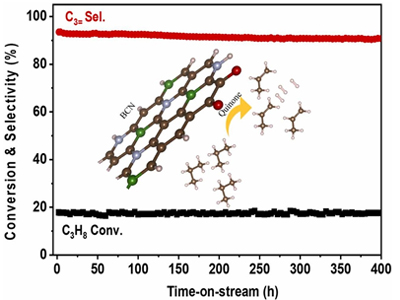
Non-oxidative propane dehydrogenation (PDH) is one of the most important on-purpose techniques for bridging the supply-demand gap of propylene. Pt and Cr-based catalysts are the commercial catalysts for the PDH process. However, the high cost of Pt, environmental impact of Cr, and rapid catalyst deactivation which requires frequent regeneration resulting in CO2 emissions are some of the major challenges. Here we report a metal-free borocarbonitride (BCN) catalyst that exhibits exceptional catalytic activity and stability. The as-synthesized catalyst achieved a propane conversion of 17.8% with 94% propylene selectivity at 600 °C. Time-on-stream (TOS) stability test at 600 °C shows that BCN retains its initial activity even after 400 h in a single run. The stable nature of active sites and insignificant coke formation rates are believed to be the reasons for such performance. Based on experimental characterizations and DFT calculations, we propose that quinone functional groups are the active site and catalyst regeneration happens via the release of a hydrogen molecule.
Collaborative Works
Abstract

Ecofriendly agricultural practices encourage pheromone usage, but cost is a major limitation for pheromone-based techniques. Hence, various slow-release technologies have been developed to provide—controlled release, reducing the cost of source compounds. Here, we have identified a graphene oxide edifice that allows the controlled release of a complex pheromone cocktail with compounds having different polarities through ratio-metric molecular pockets. These pockets resemble liquid crystals and show both controlled release as well as stimulus-responsive burst release without charring. These properties are beneficial for pest control.
Abstract
SYNGAP1 is a Ras GTPase-activating protein that plays a crucial role during brain development and in synaptic plasticity. Sporadic heterozygous mutations in SYNGAP1 affect social and emotional behaviour observed in intellectual disability (ID) and autism spectrum disorder (ASD). Although neurophysiological deficits have been extensively studied, the epigenetic landscape of SYNGAP1 mutation-mediated intellectual disability is unexplored. Here, we have found that the p300/CBP specific acetylation marks of histones are significantly repressed in the hippocampus of adolescent Syngap1+/− mice. Additionally, we observed decreased dendritic branching of newly born DCX+ neurons in these mice, suggesting altered adult hippocampal neurogenesis. To establish the causal relationship of Syngap1+/− phenotype and the altered histone acetylation signature we have treated 2–4 months old Syngap1+/− mice with glucose-derived carbon nanosphere (CSP) conjugated potent small molecule activator (TTK21) of p300/CBP lysine acetyltransferase (CSP-TTK21). The enhancement of the p300/CBP specific acetylation marks of histones by CSP-TTK21 restored synaptic functions, increased dendritic branching of DCX+ neurons, enables the capability to reorganise cortical circuits in response to change in the sensory stimuli, and improves behavioural measures in Syngap1+/− mice that are very closely comparable to wild type littermates. Further, hippocampal RNA-Seq analysis of these mice revealed that the expression of many critical genes such as Adcy1, Ntrk3, Egr1, and Foxj1 which are key regulators of synaptic plasticity and neurogenesis and are well associated with ID/ASD reversed upon CSP-TTK21 treatment. This study could be the first demonstration of the reversal of autistic behaviour and neural wiring upon the modulation of altered epigenetic modification(s).
Abstract
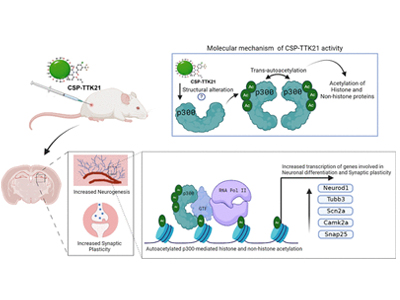
Epigenetic modifications play a pivotal role in the process of neurogenesis. Among these modifications, reversible acetylation fine-tunes gene expression for both embryonic and adult neurogenesis. The CBP/KAT3A and its paralogue p300/KAT3B are well-known lysine acetyltransferases with transcriptional coactivation ability that engage in neural plasticity and memory. The exclusive role of their KAT activity in neurogenesis and memory could not be addressed due to the absence of a p300/CBP modulator, which can cross the blood–brain barrier. Previous work from our laboratory has shown that a small molecule activator, TTK21, specific to CBP/p300, when conjugated to glucose-derived carbon nanospheres (CSP), is efficiently delivered to the mouse brain and could induce dendritic branching and extend long-term memory. However, the molecular mechanisms of p300 acetyltransferase activity-dependent enhanced dendritogenesis are yet to be understood. Here, we report that CSP-TTK21 treatment to primary neuronal culture derived from mouse embryo enhances the expression of five critical genes: Neurod1 (central nervous system development), Tubb3 (immature neural marker), Camk2a (synaptic plasticity and LTP), Snap25 (spine morphogenesis plasticity), and Scn2a (propagation of the action potential). Activation of these genes by inducing the p300/CBP KAT activity presumably promotes the maturation and differentiation of adult neuronal progenitors and thereby the formation of long and highly branched doublecortin-positive functional neurons in the subgranular zone of the dentate gyrus.
Abstract
Glucose-derived carbon nanospheres (CSP), uniquely derived by hydrothermal condensation process, inherently cross blood–brain-barrier (BBB) but distribute all over the brain. Albeit its potential to treat glioma as an effective drug delivery system, it is challenging to restrict drug-associated CSP within the glioma region and reduce non-specific side effects. Incidentally, gliomas moderately express sigma receptors (SR). Earlier, a cationic lipid-conjugated neuropsychotic drug, haloperidol (H8) is developed with SR-targetability and anticancer effect but with zero BBB-crossing ability. In this study, the CSP surface is modified with H8 (CH8 nano-conjugate) and dual targeting is achieved within glioma-tumor microenvironment: 1) glioma cells and 2) pro-proliferative M2 tumor-associated macrophages (TAM), as both express SR. CH8-treatment increases the survivability of orthotopic glioma-tumor bearing mice and significantly reduces tumor burden in the glioma-subcutaneous model. Further CH8-surface is modified by combining the brain tumor drug, carmustine (CH8-CRM). CH8-CRM nano-conjugate selectively enhances the survivability of orthotopic glioma-carrying mice and reduces tumor aggressiveness significantly in comparison to other treatment groups. Lysates from CH8-CRM-treated tumor show upregulation of cleaved-caspase 3, p53, but downregulation of pAkt. The combination treatment pronouncedly enhances the anti-glioma effect of H8. Conclusively, CH8-mediated dual-targeting via SR within orthotopic glioma-associated mice exemplifies the repurposing of neuropsychotic drugs for treating glioma.
Abstract
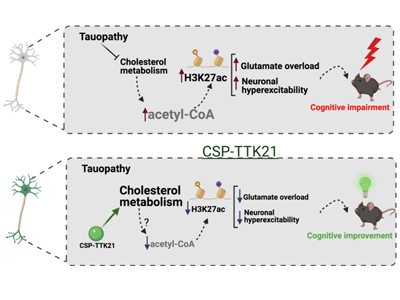
Aging is the main risk factor of cognitive neurodegenerative diseases such as Alzheimer's disease, with epigenome alterations as a contributing factor. Here, we compared transcriptomic/epigenomic changes in the hippocampus, modified by aging and by tauopathy, an AD-related feature. We show that the cholesterol biosynthesis pathway is severely impaired in hippocampal neurons of tauopathic but not of aged mice pointing to vulnerability of these neurons in the disease. At the epigenomic level, histone hyperacetylation was observed at neuronal enhancers associated with glutamatergic regulations only in the tauopathy. Lastly, a treatment of tau mice with the CSP-TTK21 epi-drug that restored expression of key cholesterol biosynthesis genes counteracted hyperacetylation at neuronal enhancers and restored object memory. As acetyl-CoA is the primary substrate of both pathways, these data suggest that the rate of the cholesterol biosynthesis in hippocampal neurons may trigger epigenetic-driven changes, that may compromise the functions of hippocampal neurons in pathological conditions.
Abstract
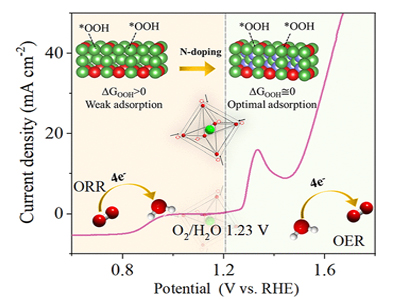
Nitrogen-doped perovskites (LaMnO3) were designed as bifunctional catalysts for oxygen reduction reaction (ORR) and oxygen evolution reaction (OER). Nitridation led to O-substitution in LaMnO3, creating distortion in the LaMnO3 structure and generating oxygen vacancies. N-doping facilitated an increase of Mn3+ content, enhancing ORR and OER activities. LaMnO3 with 4 h of nitridation exhibits 3.35 and 1.75 times higher specific and mass activities in comparison to pristine LaMnO3 (highest reported among perovskite oxides). The enhancement in catalytic activity is attributed to the increase of Mn3+ content and distorted Mn–O, leading to compressive strain. The substitution of N at the crystal lattice of perovskite stabilizes the intermediates through a combination of strain and charge modulation of the active Mn center, which causes the enhancement in ORR and OER performance. The bifunctional character of the catalyst was further evaluated for practical zinc–air battery applications in which nitrogen-doped LaMnO3 undergoes steady operation up to 500 cycles in harsh industrial conditions of 6 M KOH.
Abstract
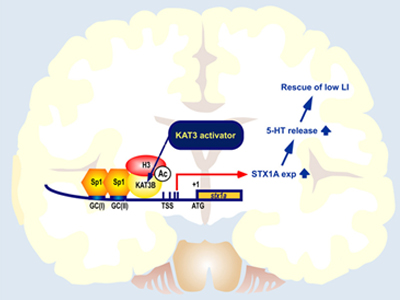
Syntaxin-1A (stx1a) repression causes a neurodevelopmental disorder phenotype, low latent inhibition (LI) behavior, by disrupting 5-hydroxytryptaminergic (5-HTergic) systems. Herein, we discovered that lysine acetyltransferase (KAT) 3B increases stx1a neuronal transcription and TTK21, a KAT3 activator, induces stx1a transcription and 5-HT release in vitro. Furthermore, glucose-derived CSP-TTK21 could restore decreased stx1a expression, 5-HTergic systems in the brain, and low LI in stx1a (+/−) mice by crossing the blood-brain barrier, whereas the KAT3 inhibitor suppresses stx1a expression, 5-HTergic systems, and LI behaviors in wild-type mice. Finally, in wild-type and stx1a (−/−) mice treated with IKK inhibitors and CSP-TTK21, respectively, we show that KAT3 activator-induced LI improvement is a direct consequence of KAT3B-stx1a pathway, not a side effect. In conclusion, KAT3B can positively regulate stx1a transcription in neurons, and increasing neuronal stx1a expression and 5-HTergic systems by a KAT3 activator consequently improves the low LI behavior in the stx1a ablation mouse model.
Abstract
The present invention describes the development of a novel, tumor epithelial cell and tumor-associated macrophage (TAM)-targeting, blood brain barrier (BBB) crossing glucose-based nanospheres (CSP). More specifically, the present invention discloses a nanoformulation and/or a composition having anticancer activity comprising of carbon nanosphere (CSP) and a sigma receptor targeting ligand (H8) in the ratio of 1:0.08 to 1:0.2, a complex prepared thereof, a process for preparation thereof and a kit for delivery of the drug molecule or the formulation or the composition to tumor site.
Abstract
Sporadic heterozygous mutations in SYNGAP1 affects social and emotional behaviour that are often observed in intellectual disability (ID) and autism spectrum disorder (ASD). Although neurophysiological deficits have been extensively studied, the epigenetic landscape of SYNGAP1 mutation-mediated intellectual disability is unexplored. Here, we have surprisingly found that the p300/CBP specific acetylation marks of histones are significantly repressed in the adolescent hippocampus of Syngap1+/- mouse. To establish the causal relationship of Syngap1+/- phenotype and the altered histone acetylation signature we have treated 2-4 months old Syngap1+/- mouse with glucose-derived carbon nanosphere (CSP) conjugated potent small molecule activator (TTK21) of p300/CBP lysine acetyltransferase (CSP-TTK21). The enhancement of the p300/CBP specific acetylation marks of histones by CSP-TTK21 restored deficits in spine density, synaptic function, and social preferences of Syngap1+/- mouse that is very closely comparable to wild type littermates. The hippocampal RNA-Seq analysis of the treated mice revealed that the expression of many critical genes related to the ID/ASD reversed due to the treatment of the specific small molecule activator. This study could be the first demonstration of the reversal of autistic behaviour and neural wiring upon the modulation of altered epigenetic modification (s).