
2020-23
Abstract

Additive free, selective decomposition of formic acid to hydrogen and carbon dioxide at room temperature is still a challenging catalytic process which often requires noble metal catalyst (Pd, AuPd, AuPt) and sodium formate as an additive. Till date, catalyst design is targeted towards minimum noble metal usage along with incorporation of basic functionalities to produce in situ formate ion (key intermediate for dehydrogenation) from formic acid. In this work, we have studied the catalytic behaviour of amino silane-functionalized graphene oxide (GO) containing palladium nanoparticles for formic acid decomposition in ambient condition. By varying amine functionalization on GO and palladium content, the best performing catalyst was obtained with 5 wt% palladium loading. Additionally, it was observed for the first time that along with stability of a catalyst in reaction medium, its interaction with decomposed products, i.e., carbon dioxide with amine functional groups plays a crucial role in recyclability of a catalyst.
Abstract
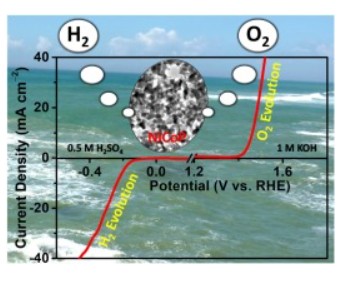
We present a simple route to synthesize of porous bi-metallic phosphides with large surface area supporting high density of electrochemically active sites, and demonstrate that resulting Ni0.2Co0.8P exhibits outstanding performance in catalysing oxygen evolution reaction (OER) under alkaline condition. It requires a very low over potential of 230 mV to achieve an anodic current density of 10 mA cm−2 with a Tafel slope of 44 mV dec−1. Ni0.2Co0.8P is also shown to perform well in catalyzing hydrogen evolution reaction (HER) under both alkaline (0.1 M KOH solution) and acidic conditions (0.5 M H2SO4 solution). Through first-principles theoretical analysis, we show that such high catalytic activity arises from the synergistic effect of Ni and Co on energies of d and p bands of Ni0.2Co0.8P, which is further enhanced by rapid mass transport possible due to the porous architecture of its three-dimensional network morphology.
Abstract
Heterointerfaces generated by inter-domain interactions on a nanoscale play a critical role in altering the activity of an electrocatalyst towards an electrochemical process. Heterointerfaces affect the surface characteristics, electronic structure, and physicochemical properties of a nanomaterial. Herein, we report an FeP–CoP heterostructure prepared by simple physical mixing of FeP and CoP nanostructures showing a remarkable performance towards water oxidation in comparison to their individual monometallic phosphides. FeP mixed with 20 wt% CoP shows a low overpotential (η10) of 220 mV as compared to FeP (η10, 325 mV). Furthermore, a high current density of 1.37 A cm−2 and mass activity of 18 987 A gM−1 were also achieved at 500 mV overpotential in 1.0 M KOH. The physical mixture shows immense stability for 200 h to achieve a high current density of 200 mA cm−2. Meanwhile the potentiostatic performance of FeP at 200 mA cm−2 decreases to an extent of 50% in 40 h. A full cell arrangement employing this catalyst as the anode material requires 1.56 V to attain a current density of 10 mA cm−2. Various characterization techniques, control experiments and theoretical studies indicate that the formation of heterointerfaces between the nano-domains of FeP and CoP results in charge transfer between Fe and Co metal sites. In addition, an oxygenated surface at the metal phosphide interface favours the sorption kinetics of intermediates involved in the reaction leading to low energy barriers in the potential determining and other steps, thus showing improved performance towards water oxidation.
Abstract
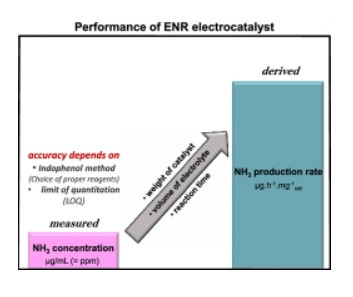
Synthesis of ammonia through electrochemical nitrogen reduction (ENR) is emerging as one of the attractive research areas in recent years, notwithstanding the enormous challenges it faces in quantification of ammonia at very low concentrations. Several reports claiming high production rate are unwittingly compromised by the accuracy of analyzing a very low concentration (<1 ppm) of ammonia in the electrolyte post-ENR reaction using the indophenol method. Therefore, in this work, we have highlighted the significance of selecting and standardizing a right protocol encompassing admissible levels of oxidants and a complexing agent, citrate (to mitigate the effect of interfering metal ions), through elaborate control experiments. In addition, the importance of setting the lowest limit of ammonia concentration that can be accurately quantified by the indophenol method is also justified. Further, the experimental observations were summarized into a protocol, which was followed to re-evaluate the performance of two well-claimed electrocatalysts for ENR reported recently in the literature.
Abstract
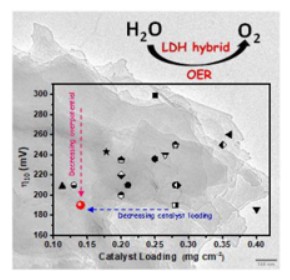
NiFe layered double hydroxide (NiFe LDH) grown in the presence of MoS2 (rich in 1T phase) shows exceptional performance metrics for alkaline oxygen evolution reaction (OER) in this class of composites. The as-prepared NiFe LDH/MoS2 composite (abbreviated as MNF) exhibits a low overpotential (η10) of 190 mV; a low Tafel slope of 31 mV dec–1; and more importantly, a high stability in its performance manifested by the delivery of current output for 45 h. It is important to note that this could be achieved with an exceedingly low loading of 0.14 mg cm–2. The mass activity of this composite (97 A g–1) is about 14 times greater than that of the conventional RuO2 (7 A g–1) at η = 200 mV. When normalized with respect to the total metal content, a mass activity of 1000 A g–1 (η = 300 mV) was achieved. Impedance analysis further reveals that the significant reduction in charge-transfer resistance and hence high current density (5 times greater as compared to NiFe LDH at η = 300 mV) observed for MNF is associated with interfacial adsorption kinetics of intermediates (R1). Significant enhancement in the intrinsic activity of MNF over LDH has been observed through normalization of current with the electrochemically active surface area. Computational studies suggest that the Ni centers in the composite act as the active sites for OER, which is well-corroborated with the observed postreaction appearance of Ni3+ species.
Abstract
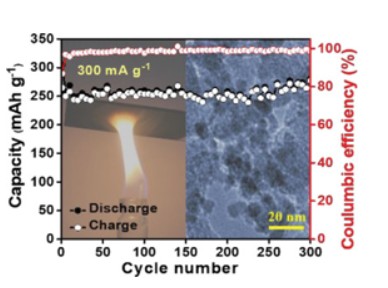
Tin-based anode materials gained prominence in battery applications owing to their high theoretical capacity, less toxicity, and low cost. However, they suffer from huge capacity losses due to severe volumetric expansion up to 300%. Herein, Sn@C (20 wt% Sn) composite synthesized by single-step combustion process showed good adherence of tin particles on graphite rich carbon which successfully minimizes pulverization with enhanced structural stability. The homogeneously dispersed tin nanoparticles exhibit a highly reversible capacity of 281 mA h g−1 at a current density of 300 mA g−1 with 98.6% capacity retention after 300 cycles.
Abstract
Aqueous electrochemical nitrogen reduction (ENR) to ammonia (NH3) under ambient conditions is considered as an alternative to the energy-intensive Haber-Bosch process for ammonia production. Many metal, non-metal, carbon-based materials along with metal-chalcogenides, metal-nitrides have been explored for their ENR activity. The reported NH3 production through ENR is still in the micro-gram level and often falls in the range of NH3 and NOx contaminations from the surrounding. The quantification of NH3 at very low concentration possess enormous challenge in this field and thus many reported ENR electrocatalysts suffer from reproducibility issue. This review highlights in detail the challenges associated with ENR in aqueous medium and necessitates standardization of protocols to quantify the low concentration of NH3 free of false-positives. It concludes the prospects of electrochemical NH3 production through lithium-mediated N2 reduction. .
Abstract
Polyaniline films are under extensive consideration for applications in sensors, memory devices, displays, biomedicals, etc., owing to their unique optical and electronic functional states that are switchable in response to external stimuli. The application arena of these materials could be enhanced by creating active, adaptive, and autonomous systems with preprogramable spatiotemporal control over the functional states. Here, we present a simple approach to achieve autonomous temporal regulation of polyaniline films’ optical and electrical states by integrating enzyme-catalyzed biochemical reaction. The enzymatic reaction produces a feedback-induced transient pH profile, and correspondingly, the functional states of polyaniline films give rise to a similar switching profile, whose lifetime could be preprogrammed via enzyme concentration. This autonomous, temporally regulated polymer film system represents an advancement to the existing switchable materials that operate at equilibrium.
Abstract
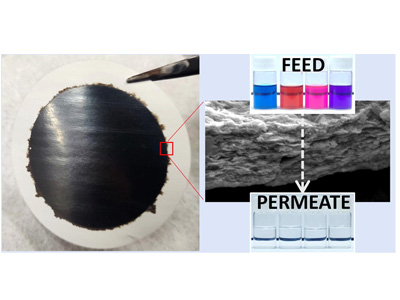
Membrane-based technology is emerging as an efficient technique for wastewater treatment in recent years. Membranes made up of two-dimensional materials provide high selectivity and water flux compared to conventional polymeric membranes. Herein, we report the synthesis and use of MoSe2 membrane for dye and drug separation in wastewater, mainly from textile and pharmaceutical industries. The as-prepared MoSe2 membrane shows ∼ 100% rejection for organic dyes and ciprofloxacin drug with a water flux reaching up to ∼ 900 Lm-2h-1bar-1. Further, the MoSe2 membrane shows lower NaCl rejection of ∼ 1.9% for the dye/salt mixture. The interlayer spacing in the MoSe2 membrane allows the water molecules and ions from the salt to pass through freely but restricts the movement of large contaminants. The membrane is stable against the bovine albumin serum fouling with a flux recovery rate of 96%. It also shows good performance even in harsh environments (pH 3–10). To the best of our knowledge, the MoSe2 membranes were fabricated for the first time for wastewater treatment application. The dye/salt separation performance of the MoSe2 membrane is significantly better than several other membranes. This work highlights the promising potential for using two-dimensional materials for textile and pharmaceutical wastewater treatment.
Abstract
The development of robust electrocatalysts with low platinum content for acidic hydrogen evolution reaction (HER) is paramount for large scale commercialization of proton exchange membrane electrolyzers. Herein, a simple strategy is reported to synthesize a well anchored, low Pt containing Vulcan carbon catalyst using ZnO as a sacrificial template. Pt containing ZnO (PZ) is prepared by a simultaneous borohydride reduction. PZ is then loaded onto Vulcan carbon to produce a very low Pt content electrocatalyst, PZ@VC. PZ@VC with 2 wt.% Pt shows excellent performance for acidic HER in comparison to the commercial Pt/C (20 wt.%) catalyst. PZ@VC with a very low Pt loading shows significantly low η10 and η100 values (15 and 46 mV, respectively). PZ@VC on coating with Nafion (PZ@VC-N) shows further improvement in its performance (η10 of 7 mV, η100 of 28 mV) with ≈300 h of stability (≈10 mA cm−2) with only 4 µgPt cm−2. PZ@VC-N shows a record high mass activity of 71 A mgPt−1 (32 times larger than Pt/C (20 wt.%) at 50 mV of overpotential. Post reaction characterizations reveal Pt nanoparticles are embedded onto VC with no traces of zinc, suggestive of a strong metal-support interaction leading to this high stability at low Pt loading.
Collaborative works
Abstract
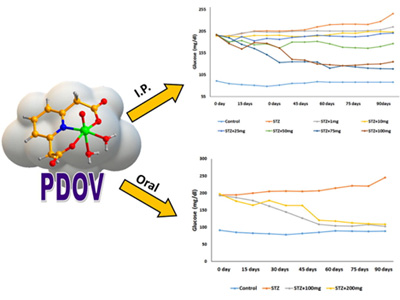
The synthesis and characterization of a novel vanadyl complex, [V(IV)O(2,6-pyridine diacetatato)(H2O)2] (PDOV) is reported. The pH-controlled release of the complex from polymer coated mesoporous silica was demonstrated for possible oral administration; results showed that release at pH 2 was significantly lower than that at pH 7.4. The said complex was subsequently screened for possible anti-diabetic activity, via an in vivo dose-response study (intraperitoneal and oral supplementation of PDOV) for 90 days in streptozotocin (STZ) induced diabetic rats. The results revealed that over a 90 day period, intraperitoneal administration of PDOV (at a dose of 75 mg/kgbw) and oral administration of the PDOV (at a dose of 100 mg/kgbw) were effective in suppressing the hyperglycemic state in the diabetic subjects. Exposure to PDOV was found to have little impact on the insulin levels of diabetics; however improved urea, creatinine, AST and ALT levels were noted.
Abstract
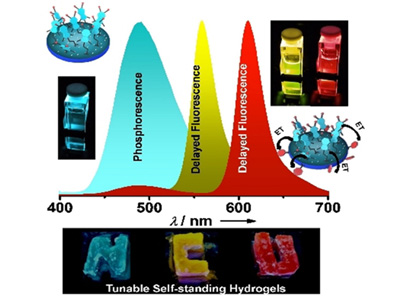
Solution phase room-temperature phosphorescence (RTP) from organic phosphors is seldom realized. Herein we report one of the highest quantum yield solution state RTP (ca. 41.8 %) in water, from a structurally simple phthalimide phosphor, by employing an organic–inorganic supramolecular scaffolding strategy. We further use these supramolecular hybrid phosphors as a light-harvesting scaffold to achieve delayed fluorescence from orthogonally anchored Sulforhodamine acceptor dyes via an efficient triplet to singlet Förster resonance energy transfer (TS-FRET), which is rarely achieved in solution. Electrostatic cross-linking of the inorganic scaffold at higher concentrations further facilitates the formation of self-standing hydrogels with efficient RTP and energy-transfer mediated long-lived fluorescence.
Abstract
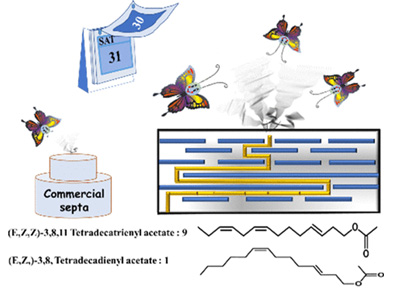
The indiscriminate use of pesticides leads to irreparable damage to the ecosystem, which motivates for sustainable alternatives like pheromone-assisted pest management. The tomato pinworm Tuta absoluta is a major threat to tomato cultivation. Moreover, its green management technology uses a pheromone trap that has a short field life. To overcome this problem, a pheromone composite with graphene oxide (GO) and amine-modified graphene oxide (AGO) that can extend the diffusion path has been developed. The composite stimulates an effective electrophysiological response in the antenna, which results in trapping of a significantly higher number of insects as compared to the commercial septa, thus qualifying it for field evaluation. Compared to AGO, the GO composite has pheromones assembled into a multilayer, which increases the pheromone diffusion path. This in turn resulted in the extension of the pheromone life that proportionally increased the pest trapped. This technique will be beneficial to farmers as they have longer field efficacy to keep the pest damage low in an environmentally friendly manner.
Abstract
The master epigenetic regulator lysine acetyltransferase (KAT) p300/CBP plays a pivotal role in neuroplasticity and cognitive functions. Recent evidence has shown that in several neurodegenerative diseases, including Alzheimer's disease (AD), the expression level and function of p300/CBP are severely compromised, leading to altered gene expression causing pathological conditions. Here, we show that p300/CBP activation by a small-molecule TTK21, conjugated to carbon nanosphere (CSP) ameliorates Aβ-impaired long-term potentiation (LTP) induced by high-frequency stimulation, theta burst stimulation, and synaptic tagging/capture (STC). This functional rescue was correlated with CSP-TTK21-induced changes in transcription and translation. Mechanistically, we observed that the expression of a large number of synaptic plasticity- and memory-related genes was rescued, presumably by the restoration of p300/CBP mediated acetylation. Collectively, these results suggest that small-molecule activators of p300/CBP could be a potential therapeutic molecule for neurodegenerative diseases like AD.
Abstract
The interruption of spinal circuitry following spinal cord injury (SCI) disrupts neural activity and is followed by a failure to mount an effective regenerative response resulting in permanent neurological disability. Functional recovery requires the enhancement of axonal and synaptic plasticity of spared as well as injured fibres, which need to sprout and/or regenerate to form new connections. Here, we have investigated whether the epigenetic stimulation of the regenerative gene expression program can overcome the current inability to promote neurological recovery in chronic SCI with severe disability. We delivered the CBP/p300 activator CSP-TTK21 or vehicle CSP weekly between week 12 and 22 following a transection model of SCI in mice housed in an enriched environment. Data analysis showed that CSP-TTK21 enhanced classical regenerative signalling in dorsal root ganglia sensory but not cortical motor neurons, stimulated motor and sensory axon growth, sprouting, and synaptic plasticity, but failed to promote neurological sensorimotor recovery. This work provides direct evidence that clinically suitable pharmacological CBP/p300 activation can promote the expression of regeneration-associated genes and axonal growth in a chronic SCI with severe neurological disability.
Abstract
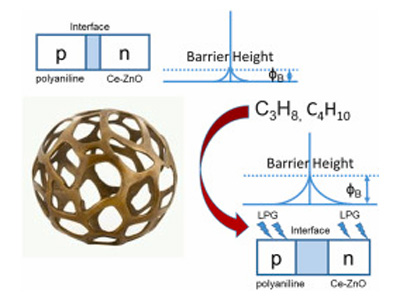
The n-type Ce doped ZnO (Ce–ZnO) and p-type polyaniline (PANI) heterojunction were successfully synthesized via simple chemical solution method for sensing liquefied petroleum gas (LPG) at standard environment. The morphology and structures of as-prepared Ce–ZnO & PANI nanoparticles were analyzed by numerous kinds of techniques. Ce–ZnO & PANI nanoparticles were mixed with n-methylpyrrolidone (NMP) which is coated over the gold coated PET electrode by doctor blade method and dried overnight at 60 °C to form p-n junction. The as-formed p-n junction is to be driven with the help of 1.5 V potential at ambient temperature. X-ray photoelectron spectroscopy results of Ce–ZnO nanoparticles confirmed the existence of Ce4+ and the improved amount of both chemisorbed oxygen and oxygen vacancy after the formation of Ce–ZnO heterojunction. The maximum response of 80% was realized for hollow Ce–ZnO/PANI sensor at 100 ppm. The proposed material is a novel candidate to detect the LPG even at low (30) ppm and this study reveals the possibility of developing a potentially inexpensive hollow Ce–ZnO/PANI sensor for sensing LPG efficiently.